
Wednesday, 7.23
Zoom, zines, and the money thing . . .
I’m writing this post in real time, during my third Worm Zoom session. Here’s my intention for today, added to the Worm Tracks spreadsheet:

That’s Mason Currey’s intention just above. I think it’s fair to show, since he’s the publisher—and I want to make a point. I’ve tried other coworking groups, and liked some of them. But the special thing here is that Mason created the group to give himself an accountability structure, which is provided by the rest of us.
Yesterday, his line in the tracker read:

Rather tiny, so—
Goal = “Finish today’s newsletter!
Result = “Getting close but not quite there”
Note = “Will be going out to you all in a couple hours, I hope!”
And so it did . . .
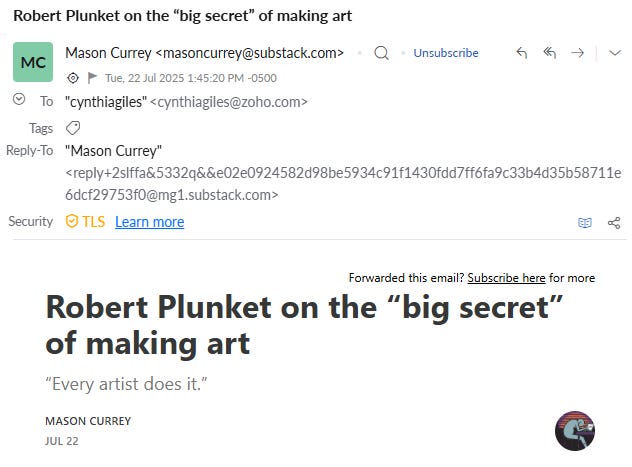
Which was four hours later, but people seem to use “a couple” to represent some small number, so I think his intention was properly fulfilled.
And I felt like I’d been part of his process in a tiny collegial way—which adds an extra dimension to the practice of “co-working.”
If you’re wondering what Robert Plunket’s “big secret” is, I’m going to spoil the suspense because I love this so much.
I did a chapter or so [Plunket explains], and I thought, this really works. But how do you create a character who’s going to propel a book along? I thought, well, he’s a lot like me—same age, same general background—so I’ll just make him me. And it actually started to work. I kept going, and I realised, I’m going to quit my job and do this the way it should be done, do it every day. And I did. I went to the New York Public Library every day, and I worked, and it started to come together. I started teaching myself how to write a novel, and that was just going over various novels that spoke to me and trying to figure out what made them work.
I have two quick observations before getting to another point:
Most people can’t quit their jobs to live at the library every day—so I think it’s lucky that we have books and workshops and (yes) Substacks that teach something about writing in a way that can be consumed in the context of real life. And since I started tuning in to this subject area, I’ve been genuinely impressed by the quality of thought and generosity of spirit offered by many writing teachers and book coaches. I plan to highlight some who seem especially Misfit-suitable.
The idea of writing myself as a character is the thing that drew me into a fiction-writing experiment. Back when everyone was talking about the possibility of humans cloning themselves, many commentators said something like “why would anyone ever want to do that?” But it seemed obvious to me: so you could raise yourself as you wish you had been raised. I don’t think that would be a good idea, but I can see the appeal. Anyway—writing yourself as a character has the same kind of vibe, allowing you to make faults into quirks, mistakes into adventures, and strengths into super-powers. Plus you can turn all the people you know into characters, and it’s like having a toy theater to play with.
I have no idea whether other people feel that way, but if you do (or don’t) it would be fun to hear from you.
Moving on . . .
So now we’re back to the topic I originally had in mind for today: the money thing.
By which I mean the relationship between writing and publishing and money. There’s a major overlap between this topic and the “Substack Success Industry,” but I’m not going much further into that today. It requires a post of it’s own, and I have it in mind for next Monday’s topic.
Instead, I’m going to take you through the rest of my day (at least as planned) for a look at how the money thing weaves in and out of writing life—even if/when you’re not making any.
We’re five minutes from the end of Worm Zoom, and I need a few minutes before a call that’s scheduled for 10:30. So I’ll take a break, then come back to tell you how it went.
I’m back—and once again the day is mostly history. I had my 10:30 call with a former client who became a friend, and now wants to write a book and get it traditionally published. I’ve spent quite a bit of time trying to explain the economic realities of the publishing industry, but people in general are quite resistant to that message.
In fact people spend a lot of money on book coaches and developmental editors. They spend a lot of time trying to find an agent. Some of them just want their story to be widely read, and some of them think authors make a lot of money from book deals. But of course it’s almost impossible to get a book noticed even if you can get it published—and most of that responsibility now falls on the author, not on the publishing house. For quite a few reasons, being traditionally published is not a road to riches for 90% of authors.
You probably know all that. And you probably know that self-publishing is a ton of work, and not free if you pay for cover designs and manuscript editors and copy editors and marketing platforms and—
No need to go on. But the lure of being “a writer” is strong!
I’ve managed to distract my friend into a different writing project, which I think might really be interesting to do, and could even have potential. So we’ve set up a weekly call to talk about it. That’s how I spent a little of this morning.
Why am I talking about this? Because I’ve been thinking about how the Misfit attitude relates to (a) getting a book published, and (b) making money from writing.
For this post I’m sticking with (a), and I’m making a confession. I don’t want to “publish” something under my name that’s really a process creation. I don’t want an editor to improve it, I don’t want a designer to lay it out, and I don’t want someone else to create a cover or write cover copy.
I want to do it all myself, every bit, then put it out in the world to find its destiny. My thing, top to bottom, start to finish.
In short—I really want to be an auteur, not just an author.
That’s partly vanity and/or obsession. But it also reflects the fact that I had several books traditionally published in the 90s, and I know it’s a crapshoot at best. Not just in terms of whether the book sells or not, but in terms of how you (and your book) are treated. I had good luck a couple of time, terrible luck a couple of other times—and I wouldn’t do it again.
Unless they gave me a big advance, in which case I would!
But “they” aren’t likely to do that, and if I’m not going to get money, I at least want to create my own vision of my own book.
If I were you (reader), I’d be thinking something like “okay, but where is the book? Have you auteured it yet?”
I’ll get back to you on that one . . .
Meanwhile—zines are having “a moment”
My second scheduled event for today was the 2 PM CDT weekly occurrence of Amber Petty’s Pitching Hour group. Some of you are fellow members, and the rest of you can find out more at Amber’s website.
Recently someone mentioned in the PH chat that they were working on a zine—and I realized that I’ve entirely missed the re-emergence of zine culture.
First I did a quick catch-up and found out that:
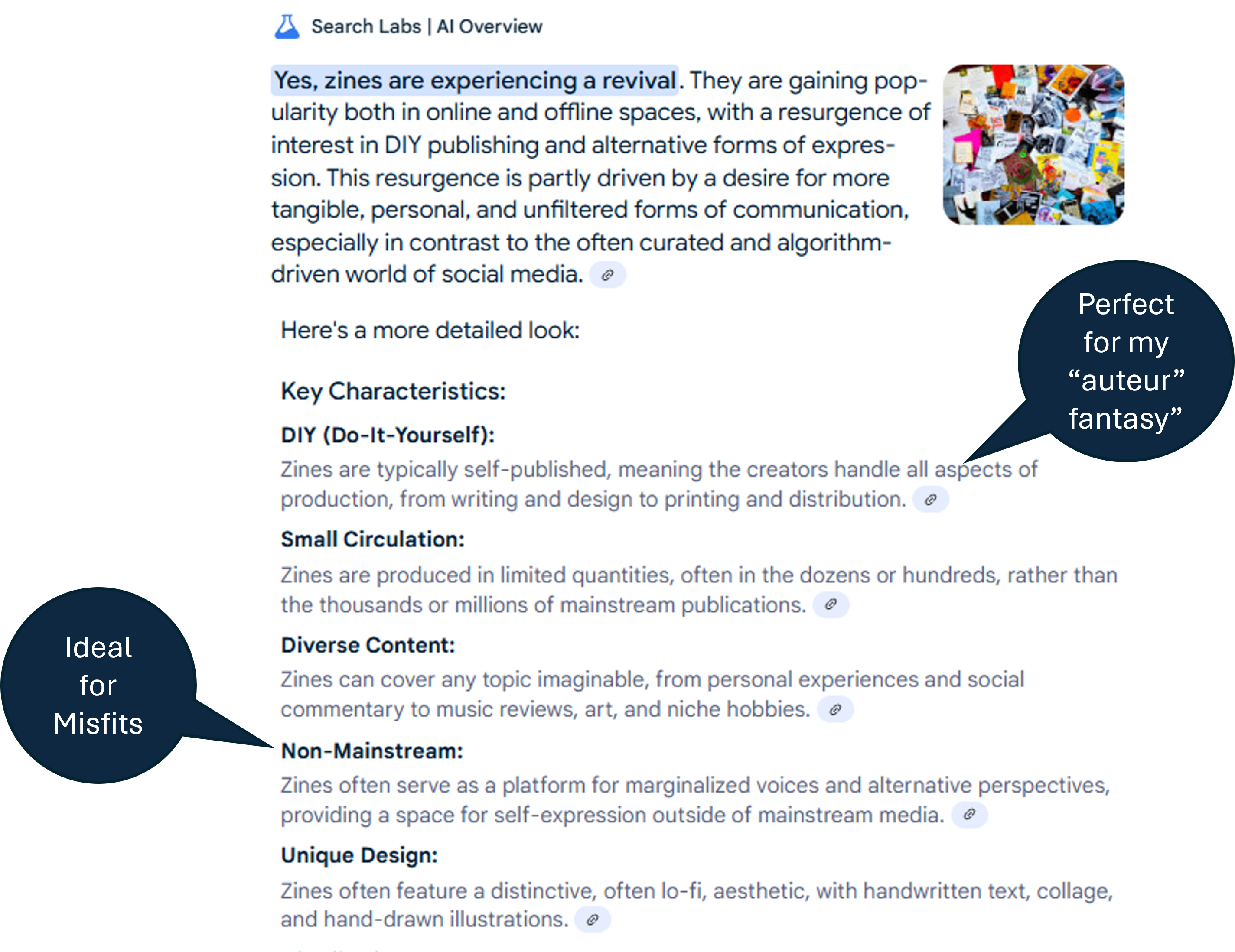
Huzzah!
Then I somehow found this delightful overview from Rachel Moss:

So I’m all in—and this morning I pitched a whimsical zine idea to my AI Assistant, who was (as always) thrilled by my fantastically brilliant idea.
The zine revival is another thing you probably knew about before I did—but in case not, check out the possibilities. My big realization was that it’s nice, at times, not to take writing quite so seriously. Although my new idea is actually concerned with something very serious, exploring it from a zine perspective seemed not only more creative but at least a little liberating.
For Friday I’m going to write about school supplies, pop-up books, and second childhood. See you then. C