
Essential Misfit Questions
Part confession, part invitation . . .

When I first thought about writing some stories for other writers, I considered what I might have to say that would be worth their reading time. Basically, I decided that I didn’t want to offer advice and/or inspiration (except in very small amounts).
I wanted to offer tools and ideas, based on my own experience.
In that spirit — here are three questions I wish I had started asking myself much sooner than I did.
Question 1. Why am I writing at all?
Different writers will come up with different answers, of course. But I think they all ultimately resolve into one of these three reasons:
(A) Because I have a talent or skill for writing and I feel a need, desire, or obligation to use it.
(B) Because a lot of people seem to be doing it, and it looks like fun — and/or easy money.
(C) Because I have something to say that will be of value to at least a few other people.
If your answer is (B), reading the rest of this story may not be very useful. But there’s no lack of advice waiting for you in the “writer services” marketplace!
As for reasons (A) and (C) . . .
For most of my life, I’ve been mostly in the A camp. Writing comes to me easily (unlike tennis or math!) and I’ve found a variety of ways to get paid for doing it. But recently I remembered something one of my grad school teachers said in class — seemingly for no particular reason:
“The real work is to overcome your own talent.”
I wish I’d asked at the time what she actually meant. But I didn’t, so I can only give my own interpretation. I believe she meant to say that it’s fairly easy to coast on your talent, or take it for granted. And that it’s much harder to push beyond the place where you feel comfortably skillful.
But I think we should take my original interpretation a little further now.
With so much content available, and more (more, more) always on the way — overcoming your own talent may also mean deciding what you can offer readers that will be original, and truly worth reading. That might be an interesting idea, valuable advice, a good story well told, or an experience shared. But it should be something you stretch for, at least a little.
Anyway, I’m giving more weight to reason C now, in my own thinking. And that brings us to question 2.
Question 2. Why am I writing this particular story / article / book / novel / play / poem / whatever?
A Buddhist monk, giving a dharma talk I once heard on tape, made me think about this question. I don’t remember who he was — which is a compliment in dharma terms, since the teaching has stayed with me, while the teacher’s identity has floated away.
Here’s how simple the teaching was:
“Whenever you get in the car, sit for a moment before starting the engine. Think about where you are going. And why.”
His point was about building a practice of mindfulness through everyday activities. Which applies to writing, if that’s something you do most days.
So consider taking that “why” pause whenever you feel tempted to start writing. You don’t have to come up with a lofty reason — you just have to get some idea of where this particular effort lies on your own map of why-ness.
I love quadrant charts, so I built this little tool. Sometimes I use a printed version (help yourself to the image!) but usually I just sketch the outlines in my notebook . . .
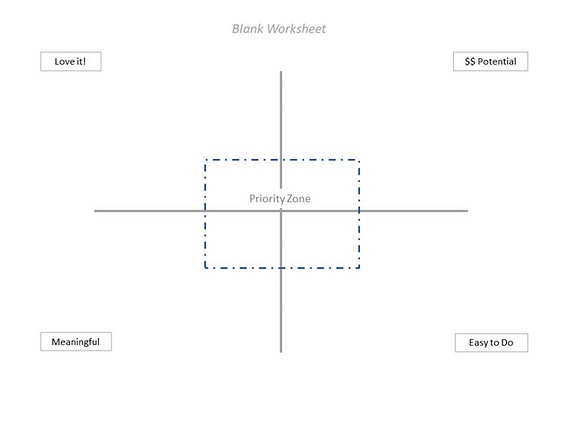
Most of the time, several categories will apply to some extent. So you can rank the boxes (1, 2, 3, 4) or put in proportions. For example, the “why” for one story might be 70% money and 30% meaning. For another it might be 10% money, 70% meaning, and 20% fun. Et cetera.
The point is not to achieve some ideal combination of factors — it’s just to go through a thought process, and identify your personal reasons for making this particular effort.
There’s an extra benefit to this exercise if you do it consistently. You’ll get to see over time whether you are keeping your reasons in balance. Or perhaps whether you are missing one component completely.
3. Do I personally have the will and the skill set needed to write this particular story?
First, the will.
I think of fifteen stories every day that I’d like to see published, with my name on the byline. Some of them I start — a title, a few notes, a paragraph. But then I run into this question: Do I want to go through the process of writing this all the way to the end?
Oftentimes, the answer is no.
I like the idea, and I’d love for the story to magically appear. But I don’t look forward to doing the actual work. Sometimes I think it’s a story I “ought” to write — something that would have value to others, or possibly earn money — in which case I might talk myself into doing it.
More often, though, that’s not the case, and I have to let go of the impulse. Or put it away in my personally huge “Attic of Ideas.”
Now for the skill set.
I’m pretty versatile, but there are some kinds of writing that I can’t do well, and can’t even fake decently. In truth — a lot of what works on Medium falls into these categories. I know, because I’ve tried and failed!
Now, after many attempts at tweaking or stretching my natural skills to meet a particular market demand, I’ve decided that the best thing is to know my own lane and stay in it.
I don’t have a neat graphic for figuring this out. But I can share another “borrowed from business” strategy: the job description.
When I was trying to reset myself as a writer (long story, told elsewhere) I struck upon the idea of creating a writing resume that would list the kinds of writing I’ve done over the course of a longish career. For each one, I added a short description of what skills were needed to succeed at that particular job.
I looked over the list and asked myself which of those things I did really well. Which ones I did just adequately. And which ones I frankly sucked at.
Won’t bore you with those details! But the whole exercise was really helpful, in a process I needed to go through. By the end, I had some ideas about the kinds of writing I would never be good at (or didn’t want to do); the kinds that come naturally to me; and the kinds I’d like to get better at.
If you try this out, you’ll come up with your own set of strengths and weaknesses. Whatever they are, they shouldn’t be seen as limiting factors — not by any means. It’s always worthwhile to explore new areas and push the boundaries of your talent.
But it’s also worthwhile to know when you’ve taken a good shot, and it’s time to refocus your efforts.
There’s a catch to all this, of course . . .
What you’re good at (and want to do) may not fit well anywhere on the market landscape — which is vast, but also crowded with other writers who want to take up the available space.
It’s worth saying, though, that asking yourself these three questions — and not once, but often — may make you a better writer, with more to offer readers. Which can’t possibly hurt your chances of success.
Hey Cynthia - I can't figure out how to DM you on Substack but we just connected on Mason's Zoom and you invited me to get in touch. Looking at your site, it seems you have exactly the solution I need. You have my email address via your subscriptions. Would you be able to reach out? Thank you so much!!