
Beautiful Books
A slightly vintage look at the intersection of interior design and bibliophilia . . .
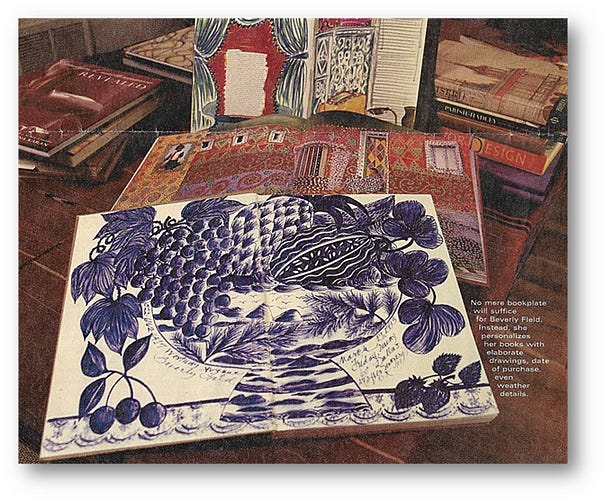
For most of of a long century, Beverly Field was a legendary maverick in the glitzy world of Dallas design. While every other top tier decorator was focused on making interiors look as sophisticated (read “expensive”) as possible, Field took an eclectic, often eccentric approach.
And she made it work, brilliantly.
Here’s how D Magazine summed up her career, after Field’s death in 2016 :
She was a master at combining the high with the low, the old with the new.
Her rooms snapped and crackled with antiques, avant-garde colors, books galore, exotic finds, humble nothings. Her interiors were like the woman herself: a whirl of opposites, extremes, moods, and moments.
The key phrase there — and the reason I’m writing this story — is “books galore.”
Short explanation: I’ve been sorting boxes full of long-saved pages. In many cases, I can’t figure out why on earth they were kept! But I’m really clear about these pages from a local lifestyle mag called (in October of 1999, anyway) Home Living.
Here’s what made such an impression on me:
Although books are treasures to Field, they are not sacred. She personalizes almost every volume with a colored drawing or sketch and a diarist’s notations about date, place of purchase or who gave the book to her. There’s even a reference to the climate, either in degrees Fahrenheit or a more evocative description, such as “barefoot weather.”
I cannot draw or even doodle. And I cannot bear to write in a book — not even a tiny marginal note. So the joie de vivre, the abandon, the talent displayed in Field’s wildly oversized “bookplates” fills me with delight, and (frankly) envy.
And that is why I’ve kept these pages in one of many boxes for now 25 years.
Since there’s no trace of the original publication left online, I’m sharing excerpts from their short article on Beverly Field’s passion for books.

Dallas interior designer Beverly Field surrounds herself with books, literally. They are stacked in precarious piles beside her bed. They lay within reach of any chair in the living room. A dinner guest, while at the table, can pluck one from the shelves lining the dining room walls. They march in serried ranks up the stairs.
Like many book lovers whose passion runs unchecked, Field must deal with where to put them all. Are they organized by category, by title alphabetically, by author, by size? Or does one just give up on the idea of an organized library and succumb to a free-for-all?
Field, ASID, recalls someone once said, “Book lovers never go to bed alone.” The 24 shelves that surround her bed are reserved for the 100 how-tos and help books she finds comfort in each night. In the dining room, books are at hand for conversation starters or to settle an argument. What intriguing conversations must come up, with The History of the Toilet, The Chinese Pavilion, Royal Style and Hollywood Costumes nearby for inspiration.
The designer and antiques dealer set up freestanding French-blue shelves that enliven her residence from dining room to living room to bedroom. Claiming there are no rules when it comes to housing books, she does try to keep them in some kind of order. On the top shelves are the oversized books, usually about art and architecture; near the bottom is her small, rare collection of British novels.
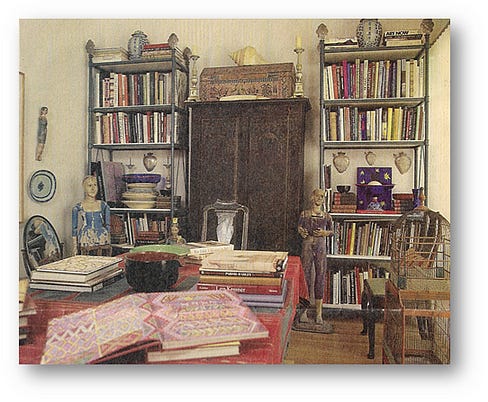
Field believes books reveal a lot about a person. (“If I see someone with a paperback romance novel. I might wonder,” she says.) The designer cannot imagine a house without two things: books and a mirror. Forget about the stereotypical decorator’s fever for furniture. “I’d rather sit on the floor and look at books and a mirror than sit in a real comfortable chair,” she says.
I’ll close with a Field quote that has nothing to with books — but captures her design ethos perfectly: “Framed children’s art will always work in a room. It adds that crude, unexpected layer.”
And as long as I’m quoting, here’s my other favorite: “Cheetah print is a neutral.”
For many of us, book-keeping becomes more of a problem than a pleasure as we age. What will become of them all? Why didn’t I read more of them—and will I ever?
But it’s not just the reading of books that matters. And while we have them, let’s enjoy looking at them. Even when they are stacked up in haphazard, tipping-over piles, we can simply admire the extra layer of meaning books give to any room, and any life.
Cynthia- I love the statement that cheetah prints are neutral. This is really a fascinating observation and insight.