
A Misfit Special Edition
Notes on Misfit-ness (and the evolution of Substack) . . .
I’ve been working on this post off and on for several weeks—basically, trying to figure out what I want to say.
And actually, I’m still not sure!
So I’m just going to share the most recent draft before it gets any more antique. And I’ll refine the message as I get started with the agenda.
Here goes . . .
Recently I went to the third weekly meeting of a productivity workgroup where I was on a month-long trial. One step in their particular process is identifying something particularly meaningful you’ve accomplished since the last session, and explaining why it was important. You have to use a particular kind of statement: “I am now the sort of person who [fill in the blank].”
I’d really been finding this process useful--much more than I’d expected. So I was looking forward to the two minutes where I would be invited to narrate my break-through accomplishment. In fact, I’d thought of a clever way to summarize in chat:
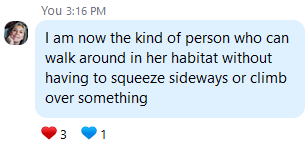
The host/coach read out my summary, paused, then said tentatively:
“Does that mean you moved some things around?”
I said well, it was bigger than that (in fact it was huge, for me anyway) and went on with a couple of quick comments. But a voice in my head was saying “Hmmm--think I misread the room!”
That’s a pretty accurate assessment, since this group is made up of online entrepreneurs rather than writers, and as I scanned the chat I realized that everyone else’s summary was just a few plain words. Same thing happened at the end when we all put our next-week commitments in the chat.
Time has passed now, and I’ve had a fairly clear realization: If I wanted to stay in the group, the best choice would be to self-edit my responses so they fit better with the overall dynamic. In which case I could treat it as an exercise in adaptation--but would I really get very much out of the experience?
I decided no.
Which is absolutely no criticism of the group or its leader, whom I find very helpful and interesting. It’s just not a good fit!
And that’s a nicer, more professional-sounding substitute for “misfit.”
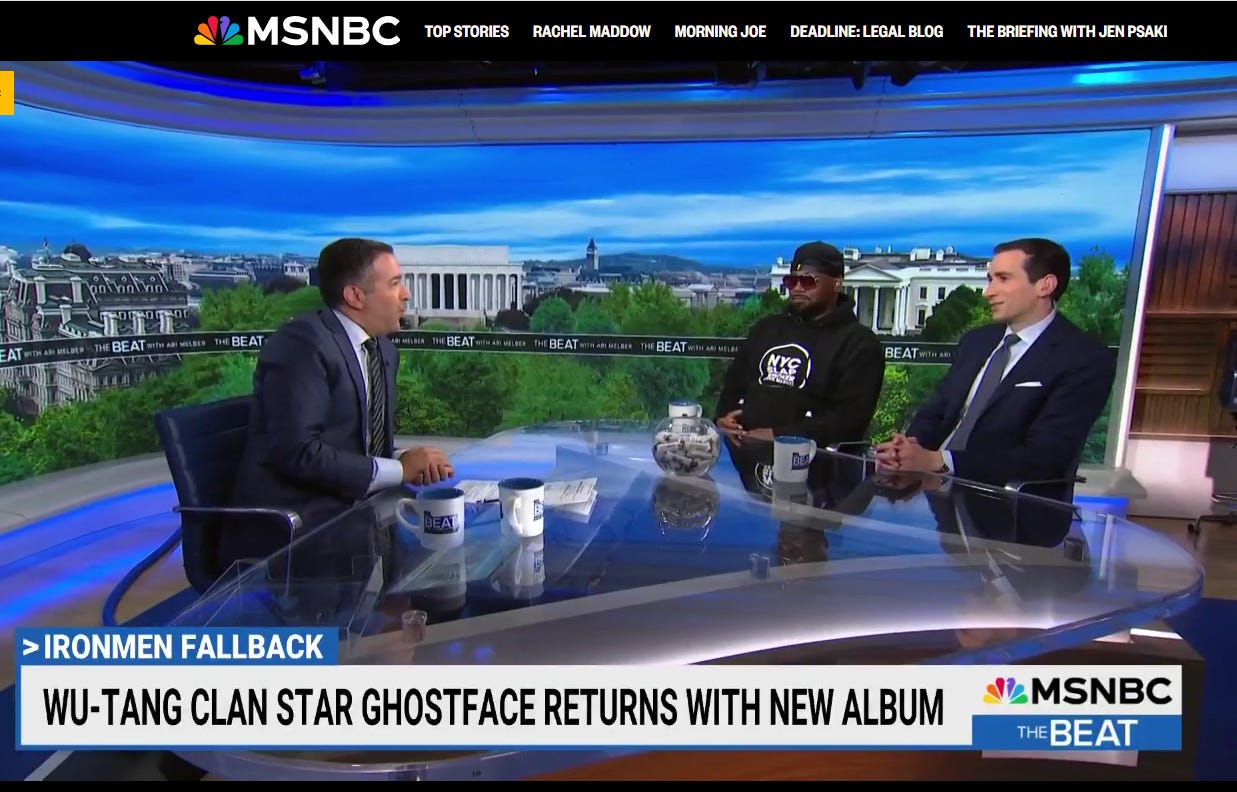
So that’s one side of today’s take on misfititude. The other side goes back a bit further to Ari Melber’s typically disorienting Fall Back segment for September 4, 2025.
If you’re not a (fairly progressive) news junkie--or a collector of weird rituals--that won’t make immediate sense. But briefly: Ari is the host an MSNBC week-night program, and he’s also (a) a middle-aged white professional, and (b) a Hip-Hop/Rap enthusiast. So right there he’s setting himself apart from the mainstream.
In the Fall Back segment that comes along at the end of some shows, Ari asks unlikely pairs of people to respond to improbable questions. And tonight’s duo was comprised of Ghostface Killah (of the iconic group Wu Tang Clan), and economics commentator Andrew Ross Sorkin.
I can’t possibly characterize the conversation--it was sort of like a verbal Cirque du Soleil, with Ghostface talking about the paparazzi, Andrew talking about the attention economy, and Ari alight with mischievous enjoyment.
If that sounds irresistible, you can watch it right here.
But in the more likely case that you already know enough, here’s my point:
Misfitting can be a group activity--and it’s fun to see what happens when people who usually fit perfectly into their surroundings are put into intentionally unfamiliar territory. In fact we have some great tropes for this, like “fish out of water, ”country mouse,” and “odd couple.”
I was just mulling this over when a third thing happened. My Inbox became increasingly filled with Substack gurus talking about “changes” and “reset.” It’s what I could call a drumbeat of frantic reorientation.
The same thing is going on, for related reasons, among the knowledge entrepreneurs (coaches, experts, etc.)—and everybody in both groups is preaching, teaching, and/or selling something to do with AI.
As I was trying to keep up with these hairpin turns and 180s, something I’ve been vaguely pondering came into sharp focus.
Substack was once a kind of haven for misfits--but is no longer.
The same thing happened at Medium, and I think I’ll soon share some history lessons about that.
But right now, I’m wondering if there’s a sort of Misfit model that uses Substack in a different way. It would take advantage of Substack’s surviving virtues (what’s left of the recommendation system, a gateless, free publishing platform, etc.), but avoid getting sucked into the evolving machinery of “Substack Success.”
Actually, I think parts of that model are already emerging, but just not labeled that way.
And that bring me to my closing point for now. I’ve been intending since the beginning of Misfit Writer to offer a series of posts about the crescendo of Substack attention/advice. But I just kept putting it off . . .
Now, since the existing Substack Success industry is well into a flurry of changes, it seems like a good time to write about:
What was—in the old Misfit days
What it became—at the peak of Success frenzy
What’s happening now—as the ground becomes very unsettled
I’ll also talk about why and how I’m diversifying my own plans so that Substack is part of a more complex strategy.
This week! For sure . . .
C
Oh yes—and here’s a party favor I think you might like!
Just click to see it.
